
Unity, Burnham, & Troy, Maine – An updated watershed management plan for Unity Pond emphasizes the need for both watershed protection and addressing internal phosphorus loading in order to reduce the pattern of severe late summer nuisance algal blooms.

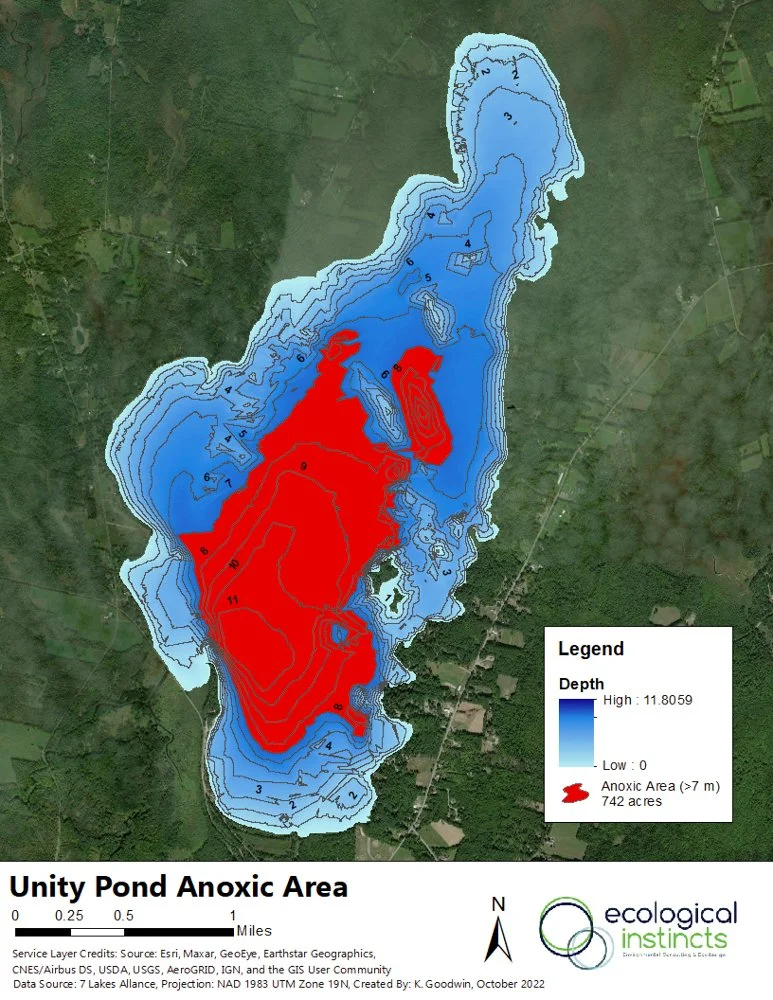


Unity Pond (aka Lake Winnecook), located in Unity, Burnham, and Troy, Maine has a history of annual severe blue-green algae blooms in the late summer. Water quality has been in decline since at least the 1970s, including decreasing water clarity and a loss of dissolved oxygen in deep areas of the lake. Unity Pond is on the Maine DEP list of impaired lakes due to nonpoint source (NPS) pollution and internal recycling of phosphorus. The impaired use is primary contact recreation and persistent algal blooms. In 2004, US EPA approved a Total Maximum Daily Load (TMDL) report for Unity Pond which examined sources of P in the lake and set a goal for meeting water quality standards.
Ecological Instincts was contracted by Waldo County Soil & Water Conservation District to develop a Watershed-Based Management Plan (WBMP) for Unity Pond in 2022, providing new strategies and realistic goals for improving water quality in the pond. This two-year project included extensive in-lake water quality sampling, water quality analysis and internal loading analysis, backflushing study, watershed survey, agriculture and forestry survey, septic vulnerability analysis, GIS mapping including a land cover update, multiple stakeholder meetings and a public meeting, and development of the WBMP.
The updated plan sets goals for reducing both the internal phosphorus load and external (watershed) phosphorus load and provides actions to achieve these goals over the next 10 years.
Project partners included: WCSWCD, Friends of Lake Winnecook, towns of Unity, Burnham and Troy, USDA/NRCS, Maine DEP, Center for Wildlife Studies, Sebasticook Regional Land Trust, Water Resource Services, and Ecological Instincts.